

Getting the day started
Showering, dressing, medication, breakfast. The unglamorous part that decides whether the rest of the day is possible at all.
Someone who already knows the way to your door.
Support in your own home, right across Wyndham. We build rosters around people who already live near you — because that is what decides whether a week holds together or quietly falls apart.
Check any of this yourself
“I have a plan and I do not really know what I am allowed to ask for.”
Nobody should have to learn a funding vocabulary to get help with a shower. Bring your plan to a Meet & Greet and we will read it with you and say plainly what it buys — including where it falls short, which is worth knowing before a review rather than after.
You might think: I have to know what I need before I call.
No. Working that out is the first thing we do together, and it is free. Turning up without the right words is the normal way to start.
“I have a plan and I do not really know what I am allowed to ask for.”
Nobody should have to learn a funding vocabulary to get help with a shower. Bring your plan to a Meet & Greet and we will read it with you and say plainly what it buys — including where it falls short, which is worth knowing before a review rather than after.
I have to know what I need before I call. No. Working that out is the first thing we do together, and it is free. Turning up without the right words is the normal way to start.
“I need to know I can trust these people with my son.”
The questions that matter are who exactly will come, what happens when that person is unwell, and who answers the phone at six. We would rather you ask all of that now than find out in March. Below you will find the people by name and the things we cannot do.
Asking hard questions will make us a difficult client. It makes you an informed one, and any provider who treats it as friction is telling you something useful about themselves.
“Different faces every week, and nobody tells me anything.”
Check the notice period in your agreement — that is the one thing worth knowing before you move. We will coordinate the handover around it, so nothing stops while it happens.
Changing means a gap in my support. It should not. The handover is our job to arrange, not yours, and it happens alongside your current service rather than after it ends.
“Can you actually staff this, in this postcode, at these hours?”
We will tell you what we can cover in Wyndham and what we cannot, by locality and by time of day, rather than accepting a referral and improvising. If we are not the right fit for a participant we will say so early enough for you to place them properly.
Every provider says yes, so the answer is meaningless. Which is exactly why ours is worth having in writing. Ask us to put the limits in the service agreement.
If your shifts keep getting moved or quietly cancelled, this is usually why — and it is arithmetic rather than carelessness.
Wyndham covers more ground than a handful of inner suburbs put together.
New estates arrive before the bus routes reach them.
The gaps between Werribee, Tarneit, Point Cook and Wyndham Vale are genuinely long.
So an arrangement that looks tidy on paper comes apart on the drive.
A worker crossing the shire between two participants absorbs that trip themselves. It is not billed to you and it is not free to them.
A two-hour visit at one end of Wyndham and another at the other end is the arrangement that stops working, because the maths does not work for the person driving.
Blocked hours close to home hold for years. Hours scattered across the shire do not, however good the intentions were when the plan was written.
So we build rosters around who genuinely lives near you, and we say plainly when we cannot. You can use this tonight, with any provider: ask them to block your hours rather than scatter them.
Six localities our coverage is on the record for, placed where they really sit. The gaps are the point.
Not listed is not the same as not covered. Tell us your street and we will say plainly what we can put near you.
Werribee
The centre, and where most of what we do here happens. Every other name on this list is placed from it.
Hoppers Crossing
Immediately north-east, sharing a boundary with Werribee. Close enough that one worker can genuinely hold a roster across both.
Point Cook
East, toward the bay — and further from Tarneit than either of them is from Werribee. The shire is wider than it looks.
Tarneit
North, and the reason this page can show you a home in your own municipality: the one Gencare supported-living house in Wyndham is here.
Truganina
The far north-east. With Wyndham Vale it makes the longest pair on this list — two localities in one council area that share almost nothing about a working week.
Wyndham Vale
West, and the closest of the five to Werribee. Also the other end of that longest pair: the same shire as Truganina, and a different roster entirely.
Coverage maps are drawn for providers. What matters is whether support reaches the handful of places your week is already made of.
Home
where almost all of it happens
The shops on Watton Street
and getting there and back
Appointments at Werribee Mercy
coordinated around, not worked around
The pool, the park, the library
the ordinary week
TAFE, work, volunteering
whatever you are building towards
Named as the geography of an ordinary Wyndham week. None of these is a partnership, a premises or an endorsement — they are simply where life happens here.
A real answer, straight away. Tap one of ours to see how it answers, or type your own.
Checked: Tarneit
Yes — that is one of the localities our coverage is on the record for.
What we cannot promise before meeting you is a named worker at a named hour. That depends on who actually lives near your street and the times you need, and we would rather say so now than after you have signed something.
Tell us your streetNothing you just checked was sent to us, stored, or used to contact you.
Yes — that is one of the localities our coverage is on the record for. What we cannot promise before meeting you is a named worker at a named hour. That depends on who actually lives near your street and the times you need, and we would rather say so now than after you have signed something.
Almost certainly — you are in the part of Melbourne where our team is most established. What no widget can tell you is a named worker at a named hour. Tell us the street and we will tell you what we can genuinely put near you, including if the answer is not yet.
That is outside the area this page covers — which is not the same as outside Gencare. We work across Melbourne and regional Victoria, so the useful next step is the page closest to you rather than an enquiry this one could not serve well.
Both of these are a qualified worker who wants the job. Only one of them is still there in March.
Ten minutes away
Ten minutes away
The next suburb over
Across the city
This is why we would rather tell you that we cannot cover a time yet than fill it with somebody who will not last.
A worker who lives ten minutes away can hold a roster that a worker crossing the West Gate never will.
Seven terms you will meet in any conversation about support. The short answer is on every line — open the one that has been stopping you.
People assume: SIL is a kind of house.
What it means: Funding for the SUPPORT you receive while living in a shared or individual home — the people, the overnight cover, the help through the day.
People assume: SDA and SIL are the same funding.
What it means: Funding for the DWELLING itself — housing that is purpose-built or modified for people with very high support needs or extreme functional impairment.
People assume: respite always means going away somewhere.
What it means: Short-Term Accommodation funds the accommodation and the support you need for a short break from your usual arrangement. The support is the heart of it — which is why a break does not always have to mean going away. Depending on your circumstances, meals and some activities can be part of a stay too.
People assume: it is the same thing as respite.
What it means: Medium-Term Accommodation funds a place to stay for up to around 90 days when you are waiting to move into a confirmed long-term home. It is about safety and stability in the in-between — with support arranged around you.
People assume: the three levels are one service at different prices.
What it means: Help to understand your plan, find services, and hold them to what they agreed. Support Connection is the lightest touch; Support Coordination is the common one; Specialist Support Coordination is for situations with real risk or several systems at once.
People assume: the two budgets do the same job.
What it means: Core pays for the everyday — personal care, help at home, getting places. Capacity Building pays for things meant to reduce how much help you need later, like learning a skill or building a routine.
People assume: a provider can manage the money as well.
What it means: Not a support — a way the money is administered. Self-managed means you pay providers yourself; plan-managed means a plan manager does it; agency-managed means the NDIA pays registered providers directly.
Not something we offerNobody wakes up wanting to buy a support category. They want Tuesday to go better than it did last Tuesday. So here is a week — and the supports underneath it are the ones that make each part of it possible.
Somebody whose job is the whole week rather than one shift of it — finding the services, holding them to their agreements, and sorting it out when one falls over. In Wyndham that is mostly local knowledge: which practices have capacity, which return a call, and which appointment is worth the drive.
Support Coordination — Level 2Showering, dressing, medication, breakfast. The unglamorous part that decides whether the rest of the day is possible at all.
Getting there, being supported while you are there, getting home again. In a suburb built for cars, this is the part that quietly decides how big your week is.
A class, a group, a gym, volunteering — somewhere you are expected each week. It does more for most people than another hour of help at home.
Cleaning, laundry, the shopping, a meal that is not from a packet. Practical, undramatic, and the difference between a home and a place you sleep.
Cooking a meal start to finish. Managing a route on your own. Budgeting a fortnight. The support that is designed to reduce itself.
A short stay away, or support at home while the people who usually care for you rest properly. It is for both of you, and it is not a sign anything has failed.
Community nursing and high-intensity personal care are delivered at home too, which is often what keeps an arrangement viable as needs increase.
All seven are in Melbourne’s west, and one is in Wyndham. Two of them have been photographed, and these are those two. The other five are named underneath rather than illustrated with somebody else’s house.
All 5 frames scroll sideways — drag, or use the arrow keys.

Flat from the street to the front door, and flat again into the garage. Nothing to negotiate on the way in.
A single-storey brick home with a tiled roof, timber-clad entry and a wide double garage. The concrete driveway runs flat from the street to the front door and into the garage — no steps at the entrance. A small landscaped garden sits beside the porch.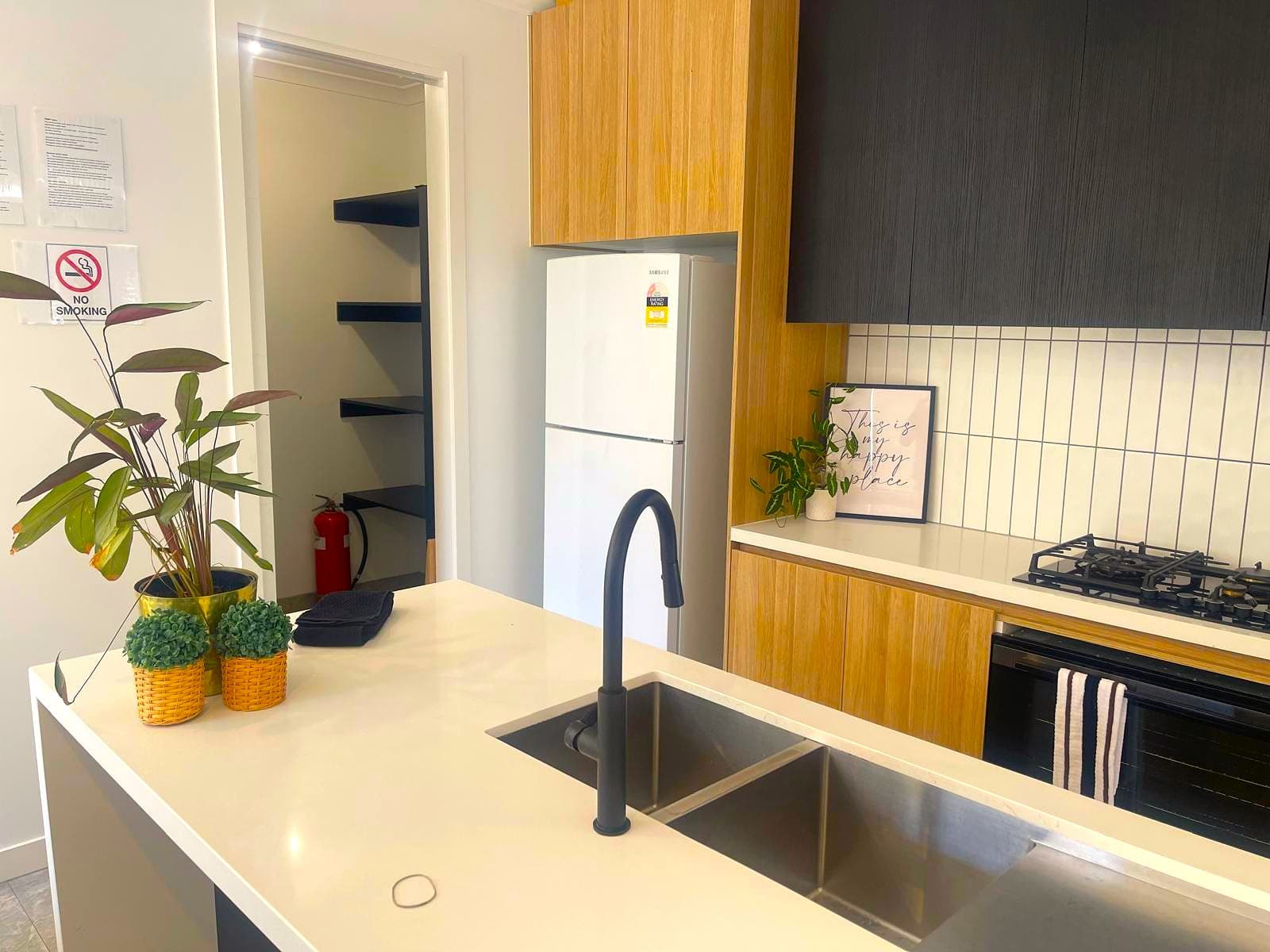
The island bench faces the living area, so whoever is cooking is never shut away from the room.
A generous kitchen with a stone island bench and double sink facing into the living area, so someone cooking is never shut away from the room. Gas cooktop, wall oven, timber and dark cabinetry, and a walk-in pantry beside the fridge.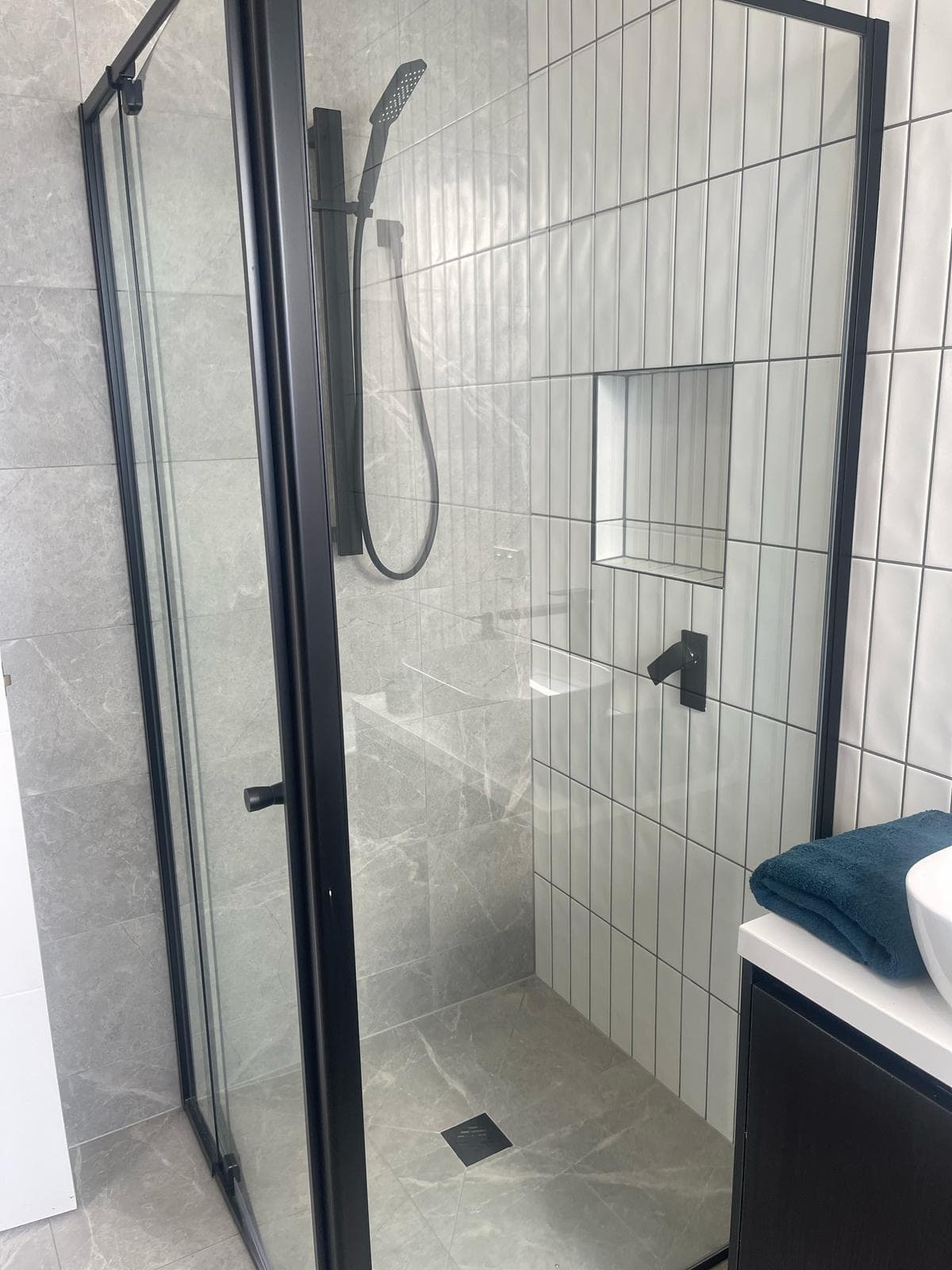
A handheld head on an adjustable rail rather than a fixed rose — which is what makes showering seated, or assisted, possible.
A fully tiled shower with a glass screen and a handheld shower head on an adjustable rail — which is what makes seated showering or being assisted possible, rather than a fixed overhead rose. A recessed shelf is set into the wall, and a vanity with a basin sits immediately alongside.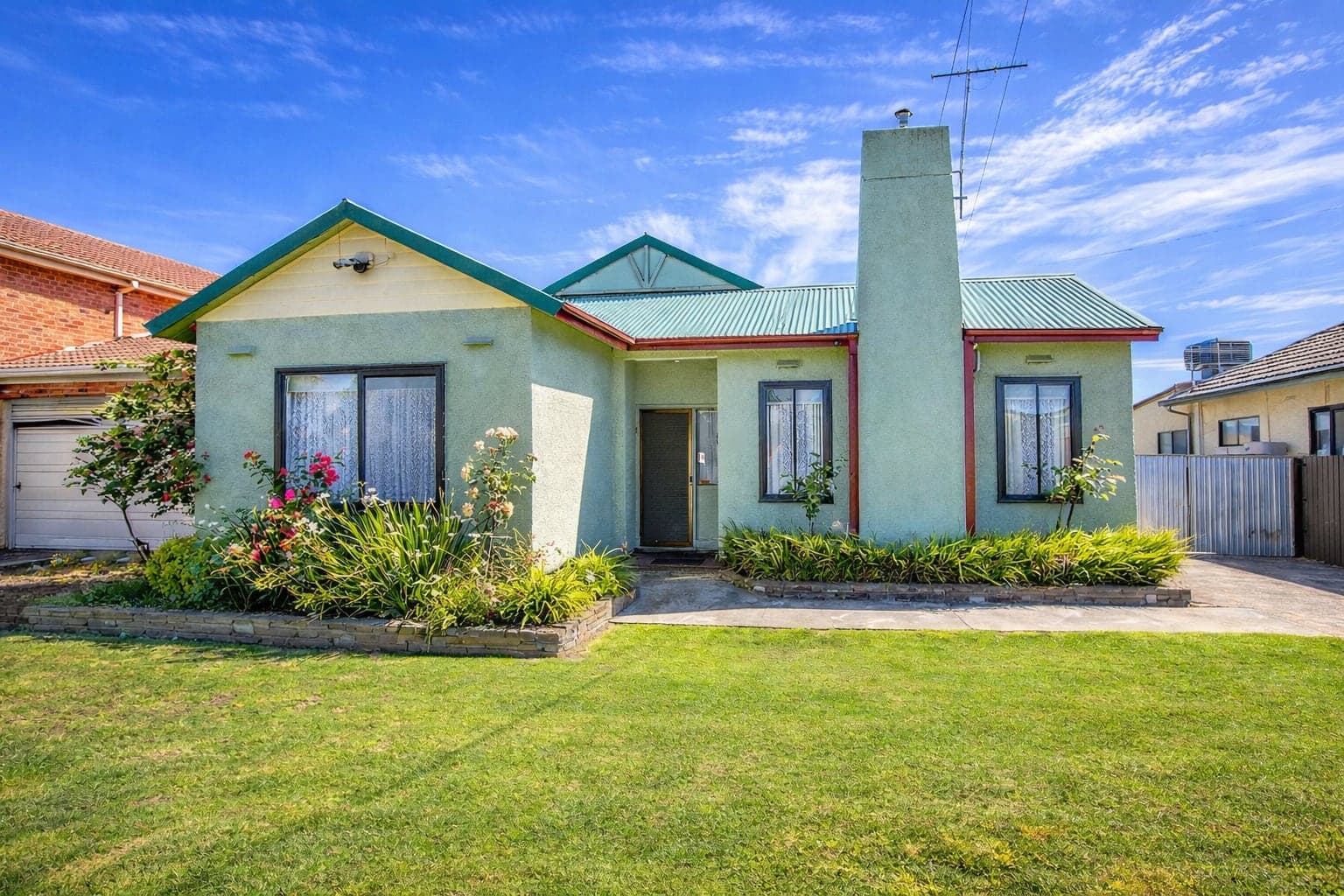
A second house, in a second suburb. There is a low step at this entry — better you see it here than on the day.
A single-storey rendered house in pale green with a pitched green metal roof and a tall chimney. A concrete path runs from the front lawn to a recessed porch and the front door; there is a low step up at the entry rather than a level threshold. Garden beds with roses and grasses sit either side, and a concrete driveway runs down the right-hand side of the property.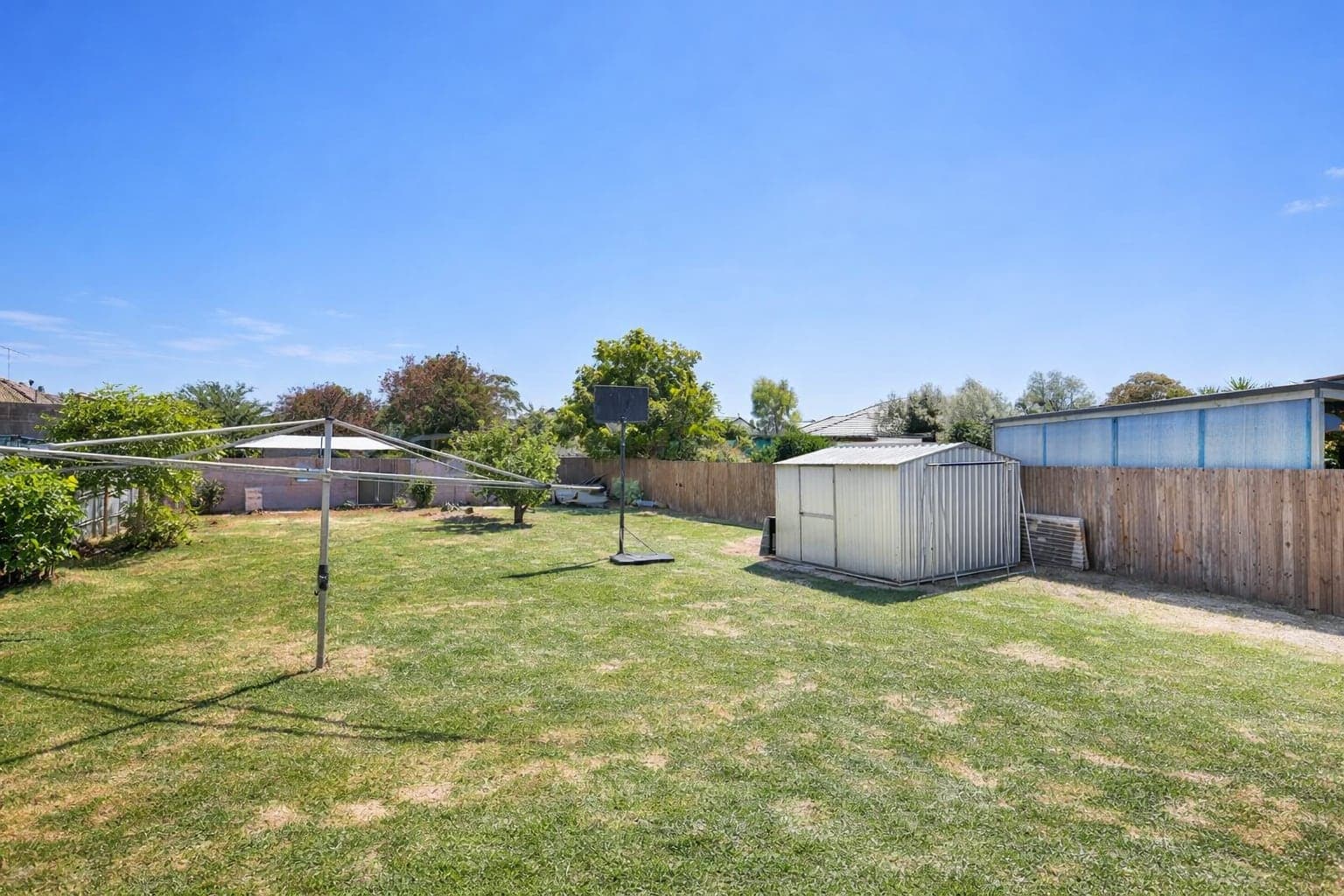
Level lawn rather than steps or terracing, a clothesline you can reach, and room to be outside without leaving the property.
A big, flat, fully fenced backyard laid to lawn, with a timber paling fence around it. There is a rotary clothesline, a freestanding basketball hoop, a metal garden shed in the corner and a few small trees along one fence. The ground is level grass rather than steps or terracing, and there is a lot of open room — enough to sit outside, hang washing, or simply be outdoors without leaving the property.Two of the seven are photographed. These five are not.
A house that is not ours is not evidence.
Photographed while the houses stood empty, before anybody moved in, which is why the rooms are bare. Nothing has been staged to look like something it is not.
The Tarneit home — the one in your municipality — is one of the five. If it is the reason you are here, the honest next step is a conversation rather than a brochure.
The five things people actually ask about when they walk in are numbered on the photograph — open whichever one matters to you.
Overnight support is on site. The house is shared, which means whether it suits you depends as much on the people already living there as on the building.
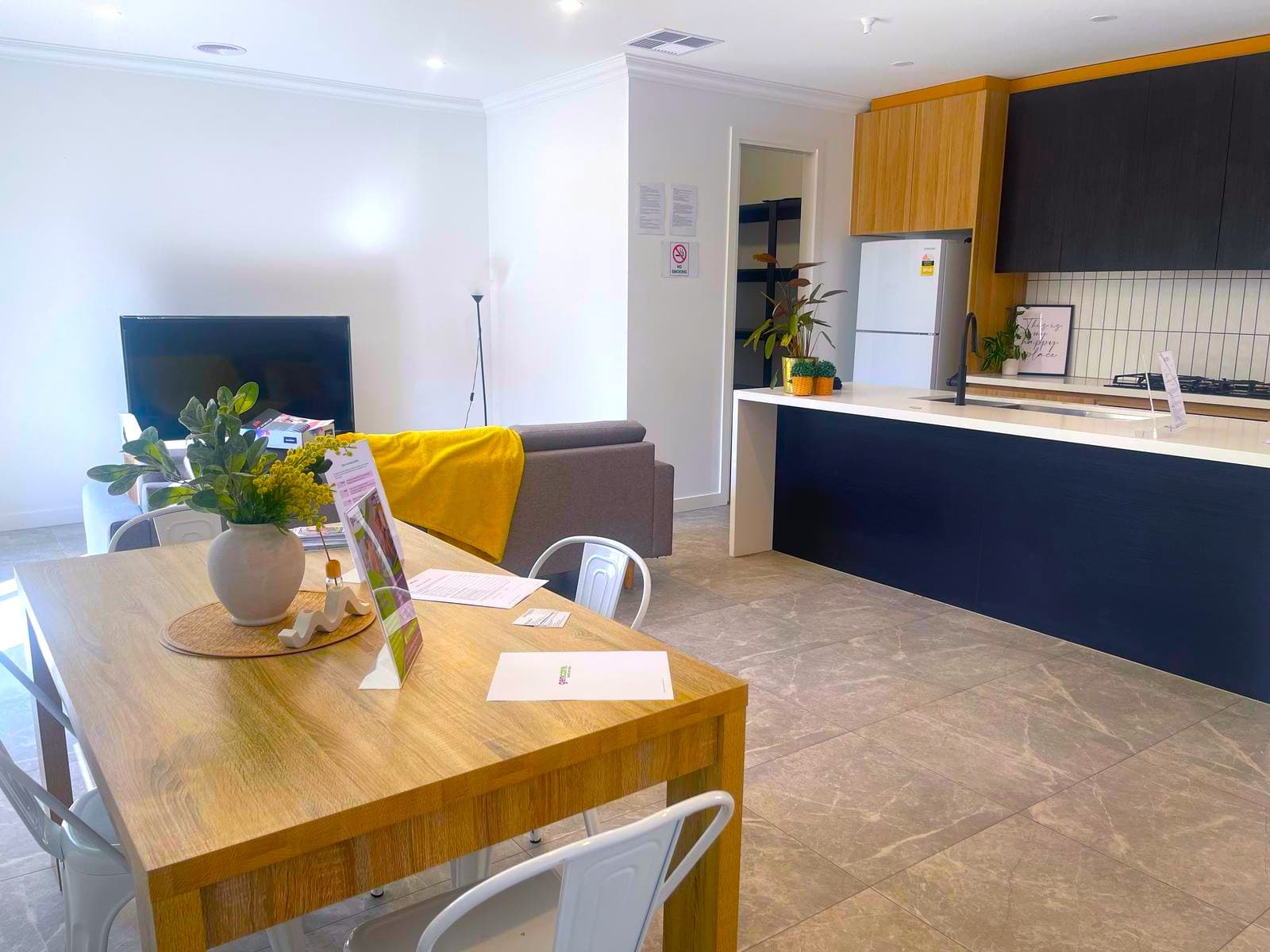
1An opening, not a door
No leaf, no handle, nothing to pull toward you while you are already moving through it.
2One bench height, and it is the standard one
Nothing in this kitchen has been lowered, and there is no knee space under the bench. If that is what decides it for you, it is worth saying before you visit rather than after.
3One surface, the whole way
Tile from the dining table through to the kitchen. No step, no threshold strip, no rug edge to lift a castor over.
4Nothing fixed in the middle
The table moves and so does every chair around it. We have not measured the turning space, so bring a tape if that is the number the decision rests on.
5The lounge is the same room
No corridor between the sofa and the table. Whoever is cooking is still in the conversation.
What this photograph cannot show you
A flat concrete driveway from the street to the front door — no step at the entrance — wide internal doorways, a level shower, and a garden you can actually get into. The driveway and the shower are both in the frames above.
Walk through it
A still frame flattens a house. Walking through one shows you the things people actually ask us about afterwards — the light, how wide the hallways really are, and where the kitchen sits in the room.
This is the Deanside house, in Melton. It is the home we can film properly, and the questions it answers are the ones the Tarneit house raises too.
Captions come through the player. A written transcript is not ready yet.
Deanside has places available, with overnight support on site.
Confirmed with our team, 20 August 2026.
Deanside is in Melton, not Wyndham. We are showing it because it is the home we can show you properly — and because the questions it answers are the same questions the Tarneit home raises.
The Deanside home in detailMost of Movement III has been about houses. For a lot of people the right answer is not a house at all, so here are both, at the same size.
Many people who ask us about a supported home end up staying where they are with more support instead. That is not a lesser outcome, and we are not paid more for the other one.
Two options, in no order
Support arrives at your own front door — the morning routine, personal care, getting to appointments, the shopping, whatever the week needs. Nothing about where you live changes. It suits most people who ask us about a home, and it can be increased later without moving.
A house with support on site, shared with a small number of other people. It suits some people very well and others not at all, and whether a place is even available depends on who already lives there. It is a bigger change, and worth taking slowly.
People arrive on this page searching for NDIS accommodation in Werribee and meet four different words used as though they were one thing. They are not. We can do three of them, and the fourth is worth knowing about before you spend an enquiry on us.
We do the people, and the stays
We do not do the building
Yes — and there is a house in your own shire
Support in a shared home, with staff on site. All 7 Gencare homes are in Melbourne’s west, and one of them is in Tarneit — the same municipality as Werribee. Whether a place is available depends entirely on who already lives there, which is not something a website can tell you.
Ask about the Tarneit homeYes — and it does not have to mean going away
A break, for everyone involved. The support is the heart of it rather than the building, so depending on your circumstances it can happen at home while the people who usually care for you rest properly. Our Deanside home also takes short stays.
Yes — for the in-between
Somewhere stable to be for up to around ninety days while a confirmed long-term home gets ready. It is about not being stuck while arrangements are made. Deanside takes these too.
This one we do not own
SDA funding pays for the dwelling itself — housing that is purpose-built or modified for very high support needs. Gencare does not own or operate an SDA-enrolled home. What we can do is help you find one that fits and provide the support inside it, which is a different job. If an SDA dwelling is what you actually need, we would rather tell you now than take an enquiry we cannot finish.
What SDA is, and how it pairs with supportThe short version: SDA pays for the building, SIL pays for the people inside it, and respite and medium-term stays cover the weeks in between. We do the people, and the stays. We do not do the building.
Pick the part of the week that is hardest. This names the supports that usually cover it and the budget the NDIS usually funds them from — so you can walk into a planning conversation knowing what to ask for.
Showering, dressing, medication, breakfast — the part that decides whether the rest of the day is possible.
Laundry, dishes, changing the sheets, keeping the place somewhere you would want a visitor.
The shops, an appointment, a class, seeing somebody — and the travel that makes any of it happen.
Somebody there overnight, either asleep and available or awake — because the risk does not stop at bedtime.
Services that do not talk to each other, appointments nobody booked, a plan nobody is driving.
A short stay somewhere else, so the people doing the unpaid work get to stop for a while.
This is not a quote and not a funding determination. It gives no dollars and no hours, because only a planner decides those, and the NDIA price limits change. What it gives you is the right words for the conversation.
Not the week in the plan. The other one — the one that does not appear in any funding line and never stops.
None of that is in a support plan, and all of it is the actual week.
The same ordinary day, with and without support in it. Small differences, on purpose — this is what it looks like when a week starts holding.
Tuesday nowYou have already been up for two hours, and the day has not started.
Tuesday with supportSomeone else does the morning routine. You drink a coffee while it is hot.
Tuesday nowThe appointment. You drive, you park, you wait, you explain it all again.
Tuesday with supportGetting there is arranged, and somebody who knows the history comes in with you.
Tuesday nowLunch standing up, between the washing and a call to the plan manager.
Tuesday with supportLunch sitting down. The washing is already done.
Tuesday nowThe hour you meant to rest in goes on the phone, chasing somebody.
Tuesday with supportAn hour that belongs to nobody but you.
Tuesday nowDinner, medications, the evening routine, and you are the only one doing it.
Tuesday with supportYou are in the room, not running it. That is a different kind of evening.
An illustration of how a week can be built — not a description of a real participant’s day, and not a promise about yours. What is possible depends on your plan and on who lives near you.
Saying that plainly is more useful than implying otherwise.
Almost everything here happens in your own home and your own community anyway — around appointments at Werribee Mercy, the shops on Watton Street, TAFE, work.
A shopfront in Werribee would not change any of that, and we are not going to open one so that a website looks better.
The first conversation happens at your kitchen table rather than a meeting room. It tells us more, and it costs you nothing to reach.
There is a Gencare supported-living home in Tarneit, the same municipality as Werribee. Not a pin on a map — a house, with people in it.
See the houseOur nearest place to meet is the Albion support hub — by appointment, so your time there is unhurried rather than spent waiting.
About the hubWhat we cannot do is give you a door in Wyndham to walk into this afternoon. If that is what you need, we would rather you knew it now than after a phone call.
Any provider can list services. The useful thing is knowing where the edges are before you sign anything. So here are three of ours.
Not until we know your hours and who actually lives near your street. Anyone who names a person on a first call is guessing, and you would find that out in week three.
Who lives there already decides that, and no website can answer it. Which is why the honest next step is a conversation rather than a brochure.
The Tarneit homePlan management decides who pays the invoice. We deliver the support. Two different jobs, and one organisation holding both is not in your interest.
None of that is a sales problem. A mismatched enquiry costs you a week and costs us a bad first meeting, and we would both rather skip it.
Two things instead of a wall of quotes: one consented family from this municipality, and a score that lives somewhere other than our own website.
The housemate matching is what sold me. They did not just fill a room — they found my son people he genuinely gets along with. The house feels like a home.
5.0
Rated on Google
22 reviews, verified June 2026
One quote, because one Wyndham family has consented to one. We are not going to borrow somebody else’s words to fill a wall.
Coordination is not delivered by a company. It is delivered by a person, and the useful question is whether that person has held a situation like yours before. So here they are, in their own words.



Specialist Support Coordinator
Over 6 years in the disability sector · At Gencare since 2020
“My practice is grounded in integrity, transparency, and genuine respect for participants and their families.”
Why I do this
I am a dedicated and compassionate Specialist Support Coordinator with over six years of experience in the disability sector, including extensive experience in specialist support coordination.
On conflicts of interest, in their own words
I confirm that I have no actual or perceived conflicts of interest that would affect my ability to provide independent, participant-centred support coordination. I am committed to full transparency and will proactively disclose any potential conflicts that may arise.
Support Coordinator
Over 5 years in the disability sector
“I believe every participant deserves a voice, choice, and control — and my role is to make the NDIS feel clear, manageable, and empowering.”
Why I do this
With over five years in the disability sector and specialised experience in support coordination, I understand the NDIS and how to help participants navigate their plans with confidence and clarity.
Support Coordinator
2 years in the disability sector · At Gencare since 2024
“Good coordination starts with listening.”
Why I do this
I am a motivated and reliable Support Coordinator, helping NDIS participants make the most of their plans and work towards their personal goals. I bring a warm, person-centred approach and I am committed to building trusted relationships with participants, their families, and the wider support network around them.
On conflicts of interest, in their own words
I declare that I hold no actual, potential, or perceived conflicts of interest that could affect my ability to provide independent, participant-focused support coordination. Should any conflict arise, I will disclose it promptly and transparently.
And the part that applies to all of us
If a specialist ever steers you toward Gencare without a good reason, tell us. If you would rather raise it outside Gencare, the NDIS Commission takes complaints directly.
Yes. Werribee sits in Melbourne’s west, which is the region where our team is most established. Support here is delivered in your own home and community rather than from a shopfront — our nearest support hub is at Albion, and there is a Gencare supported-living home in Tarneit, in the same municipality as Werribee.
Across Wyndham: Werribee, Hoppers Crossing, Point Cook, Tarneit, Truganina and Wyndham Vale. That is the list we can point to rather than the limit of where we work. Tell us your street and we will say honestly what we can put near you.
That is the right question to ask in Wyndham, because the distances are real. We roster around workers who live near you instead of sending whoever happens to be free, and if we cannot do that consistently at the times you need, we would rather tell you before you sign anything than after.
Yes, and it is one of the supports people here ask for most. A coordinator working across Wyndham needs local knowledge more than anything else — which practices have capacity, which services return a call, and which appointment is genuinely worth the drive.
There is a Gencare home in Tarneit, in the same municipality. Whether it suits depends on what you need and on the people already living there, so the honest next step is a conversation rather than a brochure. We will also tell you if a different kind of arrangement fits you better.
No. Most people prefer we come to them, and in Wyndham that is usually the sensible option — a first conversation at your kitchen table tells us more than a meeting room does. If you would rather visit, our Albion hub is the nearest and visits are by appointment.
Four steps, in the order they really happen. No timings are quoted here, because nothing on this page measures one.
Not your suburb — the street. It is the only detail that decides whether anybody we already roster lives close to you.
You find out whether we are genuinely near you, before anything else is discussed.
In person or online, whichever is easier. We listen to the week you actually have rather than the services we happen to sell.
It costs nothing, and you are under no obligation to take support from us afterwards.
Before a roster exists we check who lives near you and who has room. Sometimes the honest answer is that nobody does.
You get told plainly what we can put near you — including when that is nothing.
A roster built from people who already live close by is a roster that holds together when somebody is sick or a shift moves.
You stop re-explaining yourself to somebody new.
Not your suburb — your street. In Wyndham the difference between one end and the other is the whole question, and we would rather know it before we promise you anything.
We will tell you honestly what we can put near you, and if something else fits your situation better we will say that instead.
Start with a conversation
No forms to relive your history. Roughly what is going on, and roughly where you are, is enough.
Who are you enquiring for?